


 Bullfighters
History of Valencia Bullring: Origins, Architecture and Evolution
 03/11/2026
Valencia Bullring: An Iconic Landmark of the City
The Valencia Bullring (Plaza de Toros de Valencia) is one of the most recognisable historic buildings in the Valencian capital. Located next to Estació del Nord railway station, in the heart of the city, this impressive structure forms an important part of Valencia's architectural and cultural heritage.
Its history is closely connected to the city's urban development during the 19th century, a period of significant economic, social and architectural transformation.
Beyond its original purpose as a bullfighting venue, the bullring stands out for its monumental Neoclassical architecture, its distinctive presence in the cityscape and its role as the setting for numerous events over more than a century and a half.
When Was Valencia Bullring Built?
Construction of the current Valencia Bullring began in 1850 and was completed in 1860, although its official inauguration took place on 22 June 1859.
The architectural project was designed by Sebastián Monleón Estellés, who drew inspiration from the great Roman amphitheatres and classical architecture.
Its construction responded to the growing popularity of bullfighting and the need for a larger, more representative venue than the spaces previously used for bullfighting events.
The new bullring quickly became one of the most prominent buildings in 19th-century Valencia.
The Origins of Bullfighting in Valencia
Bullfighting traditions in Valencia date back much further than the current building. Bull-related spectacles were already documented in the city during the Middle Ages and became particularly popular from the 18th century onwards.
During those centuries, bullfights were held in various public spaces, especially Plaza del Mercado. Other locations, including Plaza de Santo Domingo and different areas near the old city walls, were also used.
In 1800, an early permanent bullring was built in the Ruzafa area, but it was demolished during the Peninsular War. Temporary venues were subsequently used until the mid-19th century, when plans were made to construct the bullring we know today.
Sebastián Monleón: The Architect Behind Valencia Bullring

The architect responsible for the Valencia Bullring was Sebastián Monleón Estellés, a Valencian architect who designed a monumental building inspired by classical Roman architecture.
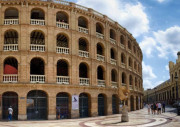
His design aimed to combine functionality, capacity and architectural grandeur. The result was a circular structure featuring an exposed brick façade and several levels of arcaded galleries.
The building resembles the ancient Roman amphitheatres, particularly through its arrangement of arches and the succession of exterior galleries.
Its most notable architectural features include:
-
A large circular structure.
-
Four levels of galleries and arches.
-
Façades built mainly with brick.
-
Decorative stone elements.
-
Cast-iron columns in some gallery areas.
-
An interior layout designed to facilitate spectator access and circulation.
At the time of its construction, the bullring could accommodate approximately 16,800 spectators, although historical sources sometimes provide different figures.
The Inauguration of Valencia Bullring in 1859

One of the most important moments in its history was its official inauguration, celebrated between 20 and 22 June 1859.
The inaugural programme featured Francisco Arjona, known as Cúchares, alongside other bullfighters of the period. Bulls from the Nazario Carriquiri and Viuda de Zalduendo ranches were used during the celebrations.
There is another particularly interesting historical detail: the bullring had already hosted bullfighting events in August 1851, while construction was still underway. José Redondo, known as El Chiclanero, was one of the leading figures at these early events.
The construction project was promoted by Valencia General Hospital, which sought to generate income through bullfighting events to support its charitable and healthcare activities.
In this way, the history of Valencia Bullring is also closely linked to social welfare and the city's institutions during the 19th century.
Major Renovations to Valencia Bullring Throughout Its History

Throughout its more than 160 years of existence, Valencia Bullring has undergone several renovations to adapt to the needs of each period.
Some of the most significant dates include:
-
1908: Installation of electric lighting. The introduction of electric lighting expanded the possibilities for hosting events.
-
1926: Renovation of the exterior enclosure. The original wall was replaced with a brick and wrought-iron fence.
-
1946: A fire at the bullring. A fire damaged a significant section of the sun-side seating, making reconstruction work necessary.
-
1966–1968: Major renovation. Extensive modifications were made to the seating areas, arena and interior facilities. The bullring reopened on 10 March 1968.
-
2011: Major refurbishment of the seating areas. Seating was renovated and various facilities were improved.
Valencia Bullring During the Spanish Civil War
One of the darkest episodes in the building's history took place during the Spanish Civil War (1936–1939).
During this period, the bullring was no longer used exclusively for bullfighting events. Instead, it was used as a prison and detention centre.
This episode forms part of the venue's historical memory and illustrates how the same urban space can serve very different purposes depending on the political and social circumstances.
Following the end of the war, the bullring resumed its bullfighting activities in April 1939.
Valencia Bullring and the Fallas Festival

Valencia Bullring has a long-standing connection with Las Fallas, one of the city's most important annual celebrations.
During the Fallas festivities, the venue has traditionally hosted numerous bullfighting events, becoming one of the best-known locations in the March celebrations programme.
Its location next to Estació del Nord railway station and close to the main shopping streets in the city centre has helped establish its presence in Valencia's everyday life and tourist landscape.
The bullring has also hosted major bullfighting events and welcomed many of the most prominent figures in Spanish bullfighting.
Where Is Valencia Bullring Located?

Valencia Bullring is located at 28 Calle Xàtiva, in a prime position in the city centre.
It stands next to Estació del Nord railway station and is within easy walking distance of other popular attractions, including Plaza del Ayuntamiento and Xàtiva metro station.
Its address and transport information are:
-
Address: Calle Xàtiva, 28, 46004 Valencia, Spain.
-
Metro: Xàtiva station, lines 3 and 5.
-
Location: Valencia city centre.
In addition to admiring its exterior architecture, visitors can explore part of its history at the Valencia Bullfighting Museum, located within the complex.
Valencia Bullfighting Museum: A Journey Through History


One of the best ways to explore the history of Valencia Bullring is to visit the Valencia Bullfighting Museum (Museo Taurino de Valencia).
This cultural space preserves and displays a wide range of objects connected with Valencia's bullfighting tradition.
Its collections include:
-
Historic bullfighting posters.
-
Old photographs and historical documents.
-
Bullfighter costumes and traditional clothing.
-
Models and materials related to the architecture of the bullring.
-
Objects illustrating the evolution of bullfighting in Valencia.
The museum offers visitors a deeper understanding of the building's historical significance and its relationship with the city's social and cultural development.
The Historical and Architectural Importance of Valencia Bullring
Valencia Bullring is much more than a venue for bullfighting events. Its architecture represents an important period in the city's urban development during the 19th century.
When it was built, it stood next to Valencia's old city walls, in an area undergoing expansion. As the city grew and urban development transformed Valencia, the bullring became integrated into one of the busiest areas of the city centre.
Its brick façade, arched galleries and Roman amphitheatre-inspired design make it a distinctive building within Valencia's architectural heritage.
Today, it remains one of the city's most recognisable landmarks and an important testament to Valencia's historical evolution.
Frequently Asked Questions About the History of Valencia Bullring
When Was Valencia Bullring Built?
Construction began in 1850 and took place mainly between 1851 and 1859, although some historical sources place the final completion of the works in 1860.
Who Designed Valencia Bullring?
It was designed by Valencian architect Sebastián Monleón Estellés, who took inspiration from ancient Roman amphitheatres.
When Was Valencia Bullring Inaugurated?
Its official inauguration took place in June 1859, with Francisco Arjona, known as Cúchares, among the main performers.
How Many People Could Valencia Bullring Accommodate?
At the time of its construction, it could accommodate approximately 16,800 spectators, although historical references sometimes give different figures.
What Is the Connection Between Valencia Bullring and the General Hospital?
Valencia General Hospital promoted its construction to use the profits from bullfighting events to finance its healthcare activities and support people in need.
Can You Visit Valencia Bullring?
Yes. The venue has areas open to visitors and houses the Valencia Bullfighting Museum. It is advisable to check opening times and access conditions before visiting.
Conclusion: A Symbol of Valencia's History
The history of Valencia Bullring is also an important part of the city's own history. From its early development in the 19th century to its present-day form, the building has witnessed major urban, social and cultural transformations.
Its monumental architecture, connection with Valencia General Hospital, historical events and proximity to some of the city's most iconic landmarks make it a place of considerable heritage interest.
Discovering its history offers a fascinating insight into Valencia's past and helps explain why the bullring remains one of the most representative buildings in the capital of the Turia.
Recommended SEO Sources and References
To strengthen the authority and reliability of the article, the following sources are worth consulting: